


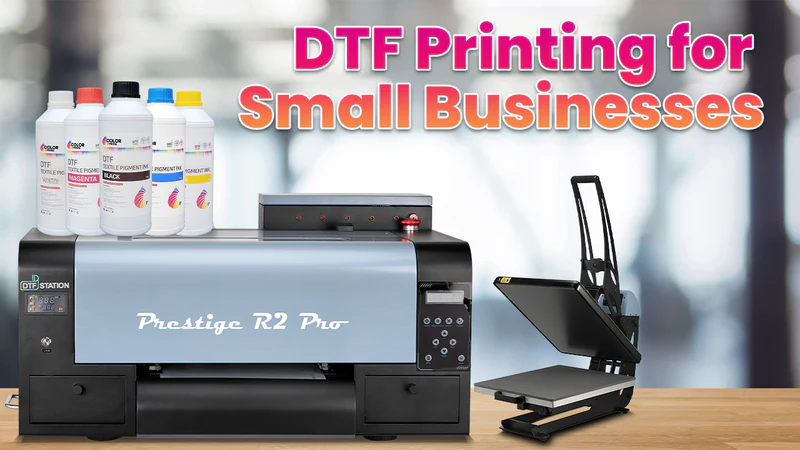
Running a small business is tough, especially when you’re trying to keep costs low and still deliver great products. If you’re in the custom apparel game—like T-shirts, hoodies, or bags—production costs can eat into your profits fast. That’s where DTF (Direct-to-Film) printers come in. They’re a game-changer for small businesses looking to save money without cutting corners on quality. In this article, we’ll break down exactly how DTF printers can slash your production costs. We’ll cover the basics, look at equipment and supply expenses, compare it to other methods, and explain why it’s a smart choice for small operations. Let’s dive in.
What Is DTF Printing and How Does It Work?
First off, let’s get clear on what DTF printing is. It’s a process where you print a design onto a special film, sprinkle adhesive powder on it, heat it up, and then press it onto fabric—like a T-shirt or tote bag. It’s pretty simple: you design on your computer, send it to the printer, and in about 5-10 minutes, you’ve got a finished product. Unlike older methods like screen printing, you don’t need fancy setups or tons of prep time. And unlike direct-to-garment (DTG) printing, you don’t have to pre-treat fabrics, which saves both time and money.
For small businesses, this matters because every dollar counts. DTF printers let you work with all kinds of fabrics—cotton, polyester, blends, even dark colors—without extra steps. That flexibility means you can take on more orders without worrying about tricky materials driving up costs. Plus, it’s beginner-friendly, so you don’t need a big team or years of experience to get started.
Low Startup Costs with DTF Printers
One of the biggest ways DTF printers cut costs is the low startup price. You don’t need to drop $10,000 like you would for a DTG machine. A solid entry-level option, like the LINKO inexpensive DTF printer, starts at around $1,650. Add in a heat press ($200-$500), a computer (maybe $500 if you don’t have one), and basic supplies—film, ink, powder—and you’re looking at $2,500-$3,000 total to get going. Compare that to screen printing, where equipment and setup can hit $5,000 easily, or DTG at $10,000+. For a small business, that’s a huge difference.
Data backs this up: a 2024 industry report says small businesses can recover their DTF printer investment after selling 500-700 shirts. If you price a shirt at $20 and your costs per shirt (blank plus materials) are $6-$8, you’re making $12-$14 profit each. Sell 100 shirts a month, and you’re netting $1,200-$1,400—your printer pays for itself in 2-3 months. That’s a fast turnaround for a small operation.
Affordable Supplies and No Minimum Orders
Supplies for DTF printing are another cost-saver. Printing a 12×12-inch design costs about $2-$3 in materials—ink, film, and powder. That’s cheap compared to DTG, where pre-treatment and ink can push costs to $5-$7 per print. Screen printing’s even worse for small runs—setup fees can be $50-$100 per design, making it pricey unless you’re doing hundreds of shirts. With DTF, there’s no minimum order. You can print one shirt or 50 without losing money, which is perfect for small businesses handling custom or low-volume jobs.
Take this example: a local event orders 10 custom tees. Screen printing might cost you $150 total ($100 setup, $5 per shirt), or $15 each—tough to profit at $20 a sale. With DTF, it’s $3 per shirt plus the blank ($5), so $80 total, or $8 each. Sell at $20, and you’re pocketing $12 per shirt—$120 profit. That flexibility keeps cash flowing without forcing you to overproduce.
Less Labor and Time Mean Lower Costs
Time is money, especially for small businesses where you’re often the one doing everything. DTF printing cuts labor costs because it’s quick and easy. There’s no pre-treating fabrics like with DTG, which can take 5-10 minutes per shirt plus drying time. Screen printing needs screen setup, ink mixing, and cleanup—hours of work before you even start. With DTF, you print, powder, press—done. A single shirt takes 5-10 minutes total, and you can train someone to do it in a day.
For a small shop, this means you’re not paying extra staff or burning hours on prep. Say you’re making 20 shirts: DTF takes about 2-3 hours, while screen printing might take 5-6 with setup. At $15/hour labor, that’s $30-$45 for DTF versus $75-$90 for screen printing. That’s real savings, especially on small batches.
Versatility Keeps Expenses Down
DTF printers work on almost any fabric—cotton, polyester, denim, even leather—without needing special adjustments. This versatility saves you from buying extra machines or supplies for different jobs. DTG struggles with non-cotton fabrics, and sublimation only works on polyester, so you’d need separate setups for variety. With DTF, one printer handles it all. A 2023 survey of small print shops found 68% chose DTF for this reason—they could expand offerings (T-shirts, hoodies, bags) without doubling equipment costs.
For a small business, this means you can say yes to more orders without extra expense. A client wants 10 cotton tees and 5 polyester hoodies? No problem—same machine, same process. You’re not stuck buying new gear or turning away work, keeping your costs steady while growing revenue.
High Quality Without High Prices
Customers want quality, but quality often comes with a big price tag—except with DTF. The prints are sharp (up to 1440 DPI), bright, and tough—lasting 50 washes without fading, per 2024 tests. That beats vinyl (which peels) and matches DTG without the high ink costs. You can charge $20-$25 per shirt and still keep materials under $3, giving you a solid $17-$22 profit margin. Customers get pro-level results, and you don’t pay extra for it.
This matters for small businesses building a reputation. Happy clients come back, and you don’t need pricey upgrades to keep them satisfied. Plus, DTF’s white ink layer means dark fabrics look just as good—no extra steps or costs like with sublimation.
Scalability for Growing Small Businesses
DTF printers grow with you, which keeps costs in check as your business expands. As orders pile up, upgrade to a $7,000 machine that pumps out 50 shirts hourly—same inks, same process, just faster. A 2024 trade report says 45% of small DTF users scaled up within two years, thanks to this smooth transition.
For a small business, this means you don’t waste money on tech you outgrow fast. You invest once, then tweak as needed. A 50-shirt order takes 5 hours on a starter printer ($75 labor at $15/hour) but just 1 hour on a bigger one ($15 labor). That $60 savings per job adds up quick.
Comparing DTF to Other Methods
Let’s stack DTF against the competition. Screen printing’s cheap for big runs ($1-$2 per shirt at 100 units) but awful for small ones due to setup costs. DTG’s quality is great, but $10,000 machines and $5-$7 per print hurt small budgets. Sublimation’s low at $2 per print, but only for polyester—useless on cotton. DTF? $2-$3 per print, any fabric, $1,650 startup. A 2024 survey found 60% of small shops picked DTF for this balance.
Maintenance is a catch—DTF needs weekly cleaning (10 minutes)—but it’s less than DTG’s daily upkeep or screen printing’s messy cleanup. For small businesses, DTF hits the sweet spot: low cost, high flexibility.
Final Thoughts
So, how can DTF printers help small businesses reduce production costs? They start cheap, use affordable supplies, cut labor time, work on any fabric, deliver quality, and scale easily. You’re looking at $2,500-$3,000 to get rolling, $2-$3 per print, and profits of $12-$15 per shirt at $20 retail. That’s a no-brainer for keeping costs low while growing your brand. Check out options at https://www.dtflinko.com/—it’s a solid move for any small business in 2025. Got a tight budget? Start small, sell smart, and watch those savings stack up.
