


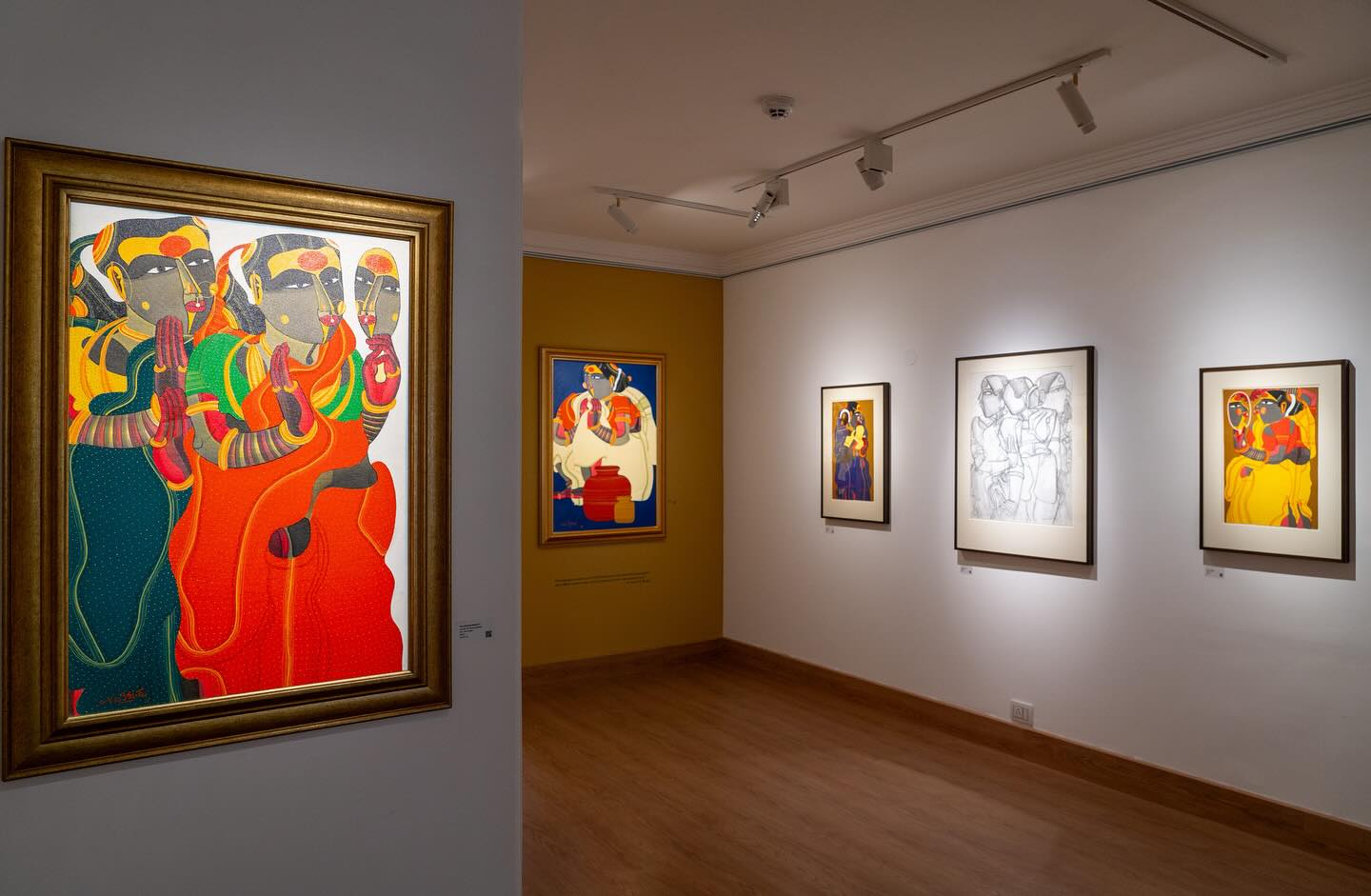
Thota Vaikuntam was born in 1942 in Boorugupalli, Andhra Pradesh. His name is highly respected among those of Indian contemporary art. His paintings are strong, emotional homages to rural Telangana, where brilliant colours, sharp figures, and minute details delineate the pastoral charm of his native place. Over the years, the Thota Vaikuntam paintings have come to be synonymous with undying admiration for the simple yet strong presence of women in the village, his muses, and his inspiration—one that has instigated the core of his artistic journey.
Early Life and Artistic Foundation
Vaikuntam’s artistic education started at the College of Fine Arts and Architecture in Hyderabad, where he obtained his diploma in 1970. His zeal for painting granted him a coveted Lalit Kala Akademi Fellowship, offering him the opportunity to study painting and printmaking at the Faculty of Fine Arts, M.S. University, Baroda, from the famous K. G. Subramanyan. This exposure to modernist thought led him temporarily to flirt with abstraction, but his heart remained nailed to the effervescent life of Telangana’s villages.
Signature Style and Themes
Vaikuntam’s work is a visual celebration of Telangana’s men and women, particularly its strong, sensuous female figures adorned in rich sarees, intricate jewellery, and large vermillion bindis. His palette is largely primary, with powerful reds, deep yellows, and rich blacks, each of which he uses to invest his subjects with an almost throbbing intensity. Unlike many artists, he shuns composite colours, believing that nature itself is best represented through its purest hues.
One of the defining elements of Thota Vaikuntam Paintings is this stylized representation of the subjects. The women, usually dark-skinned, with long almond eyes and full bodies, have an earthy sensuality and silent nobility. Furthermore, the men in his pieces, which are sometimes shown as musicians or village elders, are symbols of cultural reminiscence, which adds another dimension to his works.
A Celebrated Artistic Journey
Vaikuntam had his first solo exhibition at Kalabhavan in Hyderabad in 1973, marking the start of a successful career.
His works have been featured in notable exhibitions across the world for decades such as The Tennessee (Telangana) Icons – Grosvenor Gallery (2015), Yes, I Am He – Jehangir Art Gallery, Mumbai; and Telangana: Inheritance of a Dream Lost’ at Art Alive Gallery, New Delhi. He also is one of the leading names in group exhibitions such as the India Art Fair, Aicon Gallery, New York, and 1×1 Gallery, Dubai. He has also featured prominently in group shows at the India Art Fair, Aicon Gallery, New York, and 1×1 Gallery, Dubai.
He has been recognized worldwide for his contribution to Indian art, and for that, he has been honoured with many awards including the Bharat Bhavan Biennale Award, 1999, and the National Award for Painting, 1993.
The Influence of Thota Vaikuntam on Contemporary Indian Art
Thota Vaikuntam helps shape Indian art by mixing tradition with new forms. His paintings show the life of Telangana villages in a fresh way. The artist focuses on pure village life along with the spirit of local people mainly women to create art that speaks to all ages. A key part of his work brings village themes back to modern Indian art. When cities changed how artists painted, Vaikuntam’s art reminded people of India’s deep village roots. His bright colors as well as clear forms inspired other artists to look at local stories with new eyes. The way he paints – with natural colors or long figures – leads many artists who want to mix old art with new methods. His art appears in top shows, which takes Indian art to many countries. Vaikuntam keeps Telangana’s village stories alive through his work. His impact helps new artists grow, which makes him central to Indian art today. His art shows how village life connects to modern times. The simple beauty he captures on canvas helps people see value in traditional ways. His work proves that old stories still matter in new times.
Conclusion
Thota Vaikuntam’s paintings reflect the cultural heritage of Telangana. A personal artistic style lets him portray the daily scenes from rural life as well as Telangana’s women with grace. The bold colors along with meticulous details connect his work to local customs in a way that draws viewers to each piece.
