


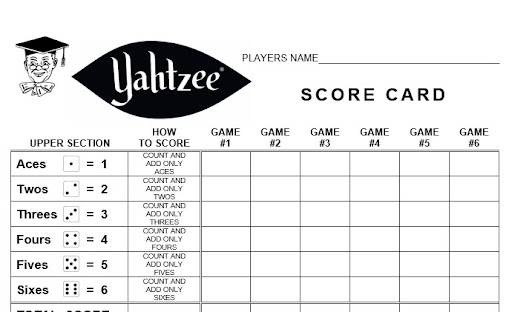
A Yahtzee Score Card is a crucial tool used to keep track of scores during the classic dice game Yahtzee.
The card is divided into two main sections: the upper section and the lower section, each containing different categories that players can score based on the combinations of dice rolled.
In the upper section, players score based on matching dice values (e.g., “Aces” for 1’s, “Twos” for 2’s, and so on).
The score for each category is determined by multiplying the value of the dice rolled by the number of matching dice. For example, if you roll three 4’s, you would score 12 points in the “Fours” category.
The lower section includes combinations like “Full House,” “Small Straight,” “Large Straight,” “Yahtzee,” and “Chance.”
Each of these combinations has specific rules on how to score based on the dice rolled. For example, a Yahtzee (five of the same number) scores 50 points, and a Full House (three of one number and two of another) scores 25 points.
The final score is calculated by summing the scores from each category. The Yahtzee Score Card is essential for organizing and tracking points, ensuring a fair and fun game experience.
How to Use the Yahtzee Score Card Effectively
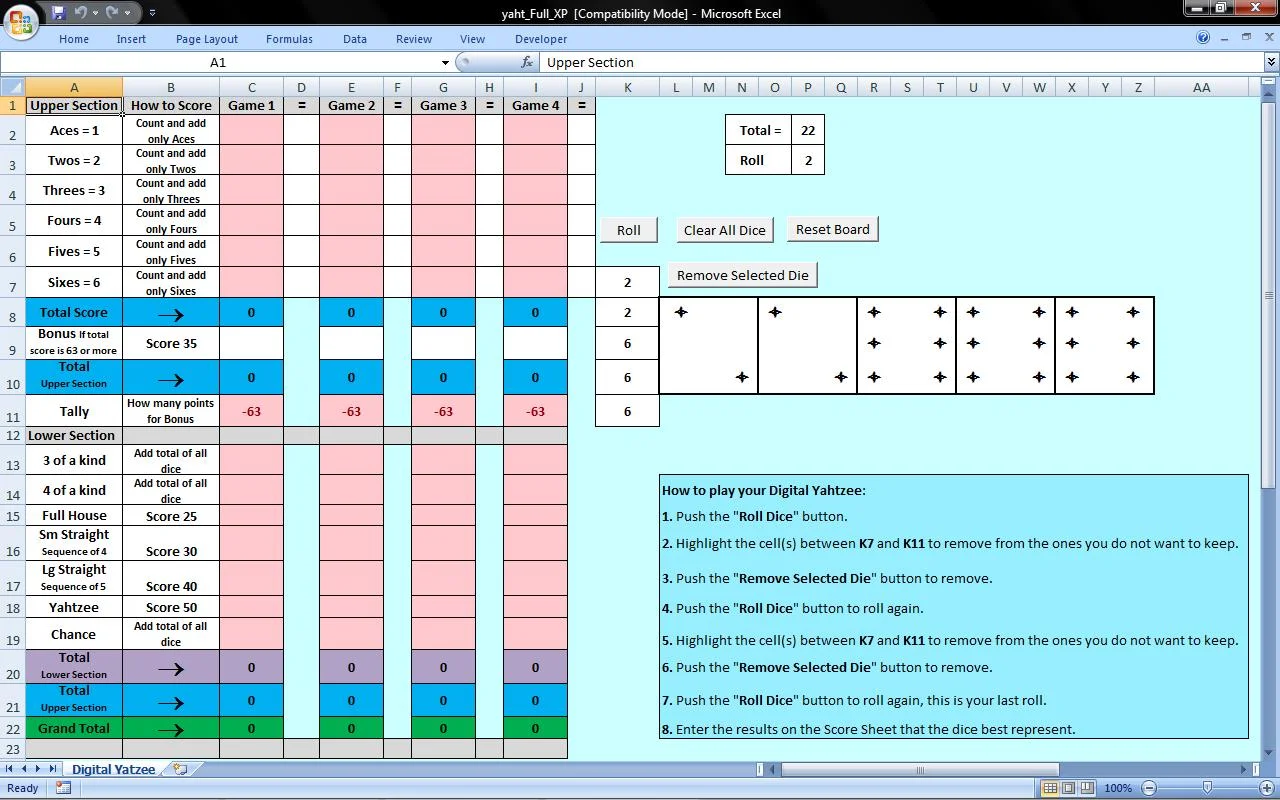
Using the Yahtzee Score Card effectively is key to mastering the game and maximizing your score.
Here’s a step-by-step guide to help you navigate the scorecard and play with strategy:
Understand the Categories
The scorecard is divided into two sections: the Upper Section and the Lower Section.
- Upper Section: Includes categories for specific dice values (Aces, Twos, Threes, etc.). The goal is to score by matching as many of the same number as possible.
- Lower Section: Contains more complex combinations such as Full House, Small Straight, and Yahtzee. These are harder to achieve, but they offer higher rewards.
Track Your Rolls and Results
After each roll, record your score in the corresponding category. Keep in mind that each category can only be scored once, so make thoughtful decisions about when to use each category. For example, if you roll four 3’s, you might choose to score them in the Threes category.
Consider the Bonus
In the Upper Section, if you score 63 or more points in total (based on the sum of each of the dice categories), you earn a bonus of 35 points. This encourages you to focus on getting high numbers early in the game.
Strategic Scoring
Sometimes, you’ll need to use certain categories to maximize your overall score. For instance, if you’re unlikely to roll a Yahtzee, you may want to fill in Chance to ensure you don’t waste a turn.
Plan for the Yahtzee Bonus
Rolling multiple Yahtzees can provide a substantial bonus. Keep this in mind when scoring your initial Yahtzee. Afterward, aim to fill in additional Yahtzees to get the Yahtzee bonus points.
Yahtzee Score Card Layout Explained
The Yahtzee Score Card Layout is designed to help players track their dice rolls and calculate their score during the game. It consists of two primary sections: the Upper Section and the Lower Section, each containing different categories for scoring.
Here’s a breakdown of the layout:
Upper Section
The Upper Section focuses on the individual dice values, where players score points based on how many matching numbers they roll. Each category corresponds to a specific number on the dice. This section includes:
- Aces (1’s): Score the sum of all dice showing 1.
- Twos (2’s): Score the sum of all dice showing 2.
- Threes (3’s): Score the sum of all dice showing 3.
- Fours (4’s): Score the sum of all dice showing 4.
- Fives (5’s): Score the sum of all dice showing 5.
- Sixes (6’s): Score the sum of all dice showing 6.
Bonus: If the total score for the Upper Section is 63 points or more, the player receives a 35-point bonus. This encourages players to aim for a higher score in this section.
Lower Section
The Lower Section contains more complex combinations. Each category requires a specific combination of dice to achieve a set score:
- Three of a Kind: Score the total of all dice if you roll three dice of the same number.
- Four of a Kind: Score the total of all dice if you roll four dice of the same number.
- Full House: A combination of three of one number and two of another. It scores a fixed 25 points.
- Small Straight: A sequence of four consecutive numbers (e.g., 1-2-3-4). It scores a fixed 30 points.
- Large Straight: A sequence of five consecutive numbers (e.g., 2-3-4-5-6). It scores a fixed 40 points.
- Yahtzee: Five dice showing the same number. It scores a fixed 50 points.
- Chance: The total of all dice, regardless of the combination. Use this category when you have no other category to score in.
Total Score
At the bottom of the scorecard, you’ll find the Total Score section, where you sum the scores from all categories. The final score is calculated by adding the points from the Upper and Lower Sections, factoring in any bonuses.
Yahtzee Bonus (Optional)
If you roll more than one Yahtzee during the game, you can earn a Yahtzee Bonus. For each additional Yahtzee, you get 100 points added to your score.
Step-by-Step Guide to Scoring on a Yahtzee Score Card
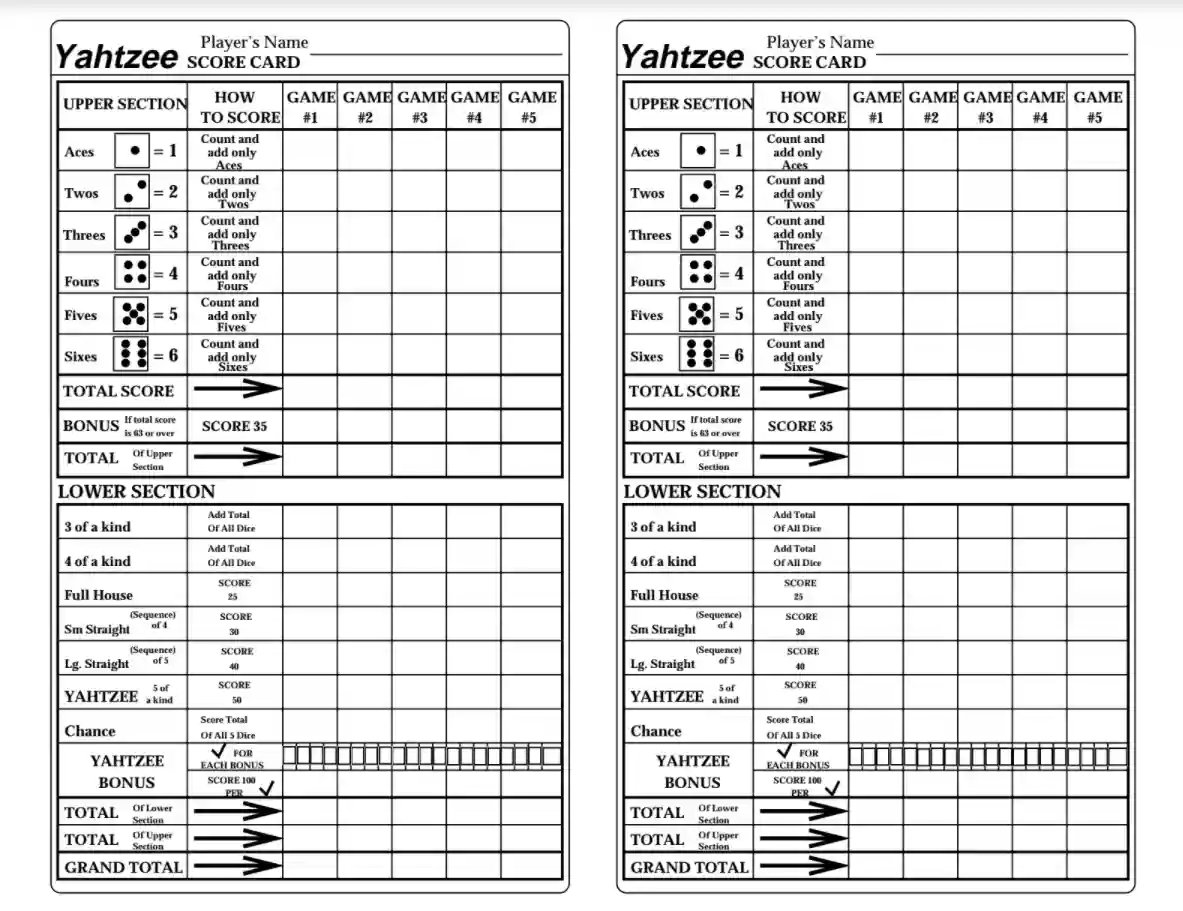
Scoring on a Yahtzee Score Card can seem a bit complex at first, but once you understand the categories and how to calculate points, it becomes much easier. Here’s a step-by-step guide to help you score on your Yahtzee Score Card:
Step 1: Roll the Dice
At the start of each turn, you roll all five dice. You can choose to keep some dice and re-roll others to try to get the best combination. You have up to three rolls per turn to achieve your desired outcome.
Step 2: Decide Which Category to Score
After your rolls, you need to decide where to place your score. You can only score in each category once per game, so be strategic about which category you use.
Step 3: Upper Section Scoring
In the Upper Section (Aces, Twos, Threes, etc.), you score based on how many dice show the same number.
- Aces (1’s): Score the sum of all dice showing 1.
- Twos (2’s): Score the sum of all dice showing 2, and so on for Threes, Fours, Fives, and Sixes.
For example, if you roll three 3’s, you would add up the 3’s and score that total in the Threes category.
Step 4: Lower Section Scoring
The Lower Section is where you can score combinations like Three of a Kind, Full House, and Yahtzee. Here’s how to score in each category:
- Three of a Kind: Score the sum of all five dice if you have three dice of the same number. For example, if you roll three 4’s, you would sum all five dice (e.g., 4+4+4+1+2 = 15).
- Four of a Kind: Score the sum of all five dice if you have four dice of the same number.
- Full House: This is a combination of three of one number and two of another (e.g., 3-3-3-5-5). You score a fixed 25 points.
- Small Straight: This is a sequence of four consecutive numbers (e.g., 1-2-3-4). You score a fixed 30 points.
- Large Straight: A sequence of five consecutive numbers (e.g., 2-3-4-5-6). You score a fixed 40 points.
- Yahtzee: All five dice showing the same number. You score 50 points.
- Chance: This category allows you to score the total of all five dice, regardless of the combination. For example, if you roll 3, 3, 5, 6, and 2, the total is 19.
Step 5: Calculate the Score for Each Category
Once you’ve decided where to place your score, write the value in the corresponding category. For categories like Three of a Kind, Four of a Kind, and Chance, you simply add up the numbers on the dice. For categories like Full House, Small Straight, Large Straight, and Yahtzee, you enter the fixed points listed for each category.
Step 6: Check for Bonuses
- Upper Section Bonus: If the total score from the Upper Section is 63 points or more, you earn a 35-point bonus. You can check this total as you go and fill it in at the end of the Upper Section.
- Yahtzee Bonus: If you roll more than one Yahtzee, you can score a 100-point bonus for each additional Yahtzee after your first.
Step 7: Total Your Score
At the end of the game, sum up the points in both the Upper Section and the Lower Section to get your total score. Don’t forget to add any bonuses you earned!
Step 8: Fill in the Scorecard
Once all categories have been filled, make sure everything is correctly entered, and tally your final score. The player with the highest score wins!
Tips for Maximizing Your Yahtzee Score
Maximizing your Yahtzee score requires a blend of strategy, good dice rolling luck, and smart decision-making.
Here are some tips to help you make the most out of your game:
Prioritize the Upper Section Bonus
Aim to score at least 63 points in the Upper Section to earn the 35-point bonus. This is key to boosting your final score.
Focus on getting high rolls in the Aces (1’s), Twos (2’s), and Threes (3’s) categories early on. Even if you don’t get a perfect score, accumulating a steady amount in the Upper Section helps you reach the bonus.
Save Your Yahtzee for Later
Use your Yahtzee category carefully. If you’re unsure about a category and haven’t yet rolled a Yahtzee, save it for that high-value combination.
A second or third Yahtzee is worth 100 bonus points. However, it’s better to hold onto the Yahtzee category for when you’re more likely to hit that perfect combination.
Don’t Waste a Full House or Small Straight
A Full House (25 points) and Small Straight (30 points) are relatively easy to achieve. If you roll a combination that could fit either, place it in that category even if you could have scored higher in another one.
These categories help you avoid using a Chance for a low roll and maximize points.
Use Chance Strategically
Don’t rush to use your Chance category. It’s often best to use it for a bad roll or to cover a category you didn’t score well in. It’s better to score a decent total in Chance than to waste a high roll on a less strategic category.
Maximize Four of a Kind and Three of a Kind
When you roll a Four of a Kind or Three of a Kind, the total of all five dice counts. If you have a pair or a trio that’s a high number, keep the rest of the dice for a chance at a higher total.
Consider using these categories early on when you get good combinations, especially if you’ve already filled in your Upper Section.
Focus on Large and Small Straights Early
The Large Straight (40 points) and Small Straight (30 points) are high-value categories. If you roll a sequence of consecutive numbers, keep them and re-roll the others to complete the set.
These categories are tough to fill, so focus on completing them early when you have a good roll.
Know When to Hold or Re-Roll
Sometimes, it’s smarter to keep certain dice and re-roll others, especially if you’re aiming for Yahtzee, Large Straight, or Four of a Kind. Don’t waste your chances by re-rolling a set that’s already good enough for a category.
Adapt Based on Your Rolls
Don’t be rigid in your strategy. If you have a bad roll, adjust your game plan. You may need to use Chance or take a risk by choosing a category that’s easier to fill.
Avoid Filling Categories Too Early
If you have a choice between filling a category that you’ve rolled or a blank category, consider holding off on filling categories like Full House or Yahtzee until you’ve seen more of the dice results.
Keep Track of Your Score as You Go
As you play, keep track of your total score and the remaining available categories. Knowing where you stand allows you to make better decisions about which categories to target.
Yahtzee Score Card Strategies for Beginners
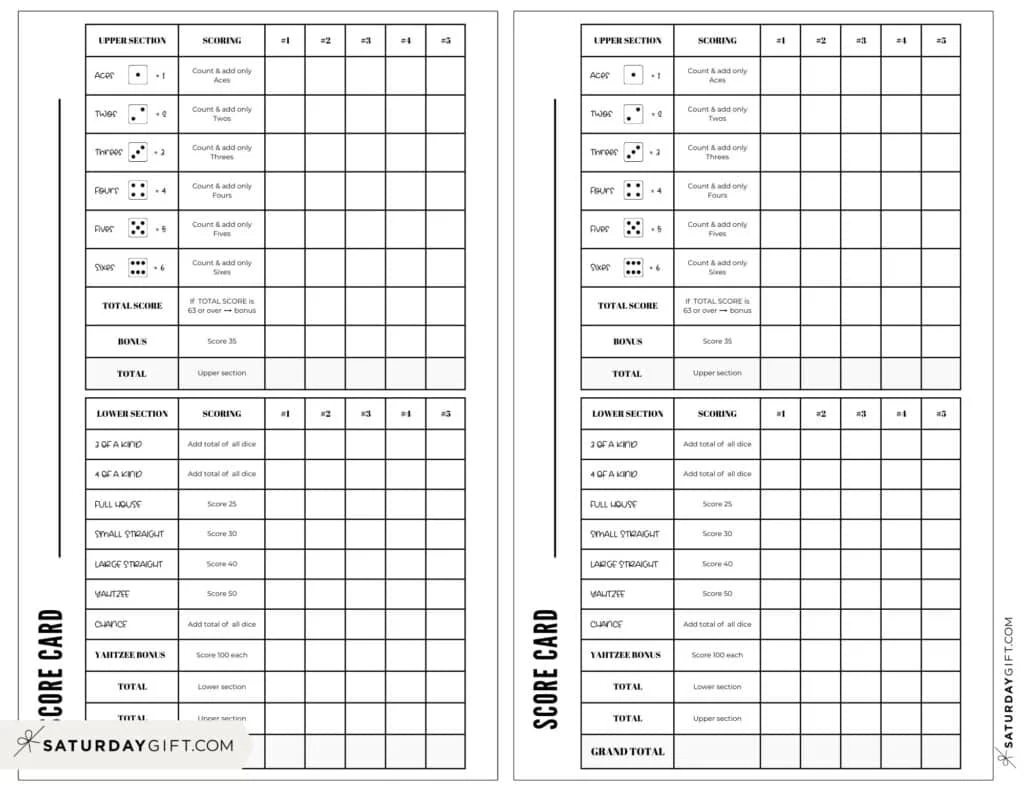
Starting with Yahtzee can seem overwhelming due to the various combinations and scoring categories. However, with a few simple strategies, you can maximize your chances of scoring high and enjoying the game more.
Here are some Yahtzee score card strategies for beginners to get you started:
1. Focus on the Upper Section
- The Upper Section of the Yahtzee scorecard consists of categories for Aces (1’s), Twos (2’s), Threes (3’s), and so on.
- Aim for 63 points (the target) in the Upper Section to earn the 35-point bonus. This will give you a solid foundation and increase your total score.
- Don’t skip categories—try to fill them as you go, even if you have a low roll. For instance, a roll of all 1’s could help you score a solid 5 points in the Aces category, which will bring you closer to the bonus.
2. Use the Chance Category Wisely
- The Chance category is there for when you have a less-than-perfect roll that doesn’t fit into any other category.
- Don’t waste it early in the game. Instead, save it for a low roll or when you need to make up points. It’s better to get a decent score in Chance than leave it blank.
3. Keep It Simple with Full House and Small Straight
- Both Full House (25 points) and Small Straight (30 points) are relatively easy to fill.
- If you roll a combination that fits into one of these categories, use it! They help keep your score going when you’re stuck with a bad roll.
- These categories are easy to achieve, so don’t wait for perfection. Take the points!
4. Don’t Overthink the Lower Section
- The Lower Section includes categories like Four of a Kind, Yahtzee, Large Straight, and Three of a Kind. While these are high-reward categories, they can be tricky for beginners.
- For Four of a Kind and Three of a Kind, focus on keeping matching dice and re-rolling the rest. If you get a high roll in one of these categories, don’t hesitate to fill it in.
- For Yahtzee (a five-of-a-kind roll), it’s tempting to hold out for a perfect roll, but keep in mind that a second or third Yahtzee can earn you an additional 100 bonus points.
5. Use the Upper Section Bonus as a Goal
- One of the best ways to boost your score is by earning the Upper Section bonus. You need 63 points in the Upper Section to earn an additional 35 points.
- Prioritize filling the Aces (1’s), Twos (2’s), and Threes (3’s) categories early in the game to make sure you don’t fall short of the bonus.
6. Take Advantage of Small Wins
- Sometimes it’s better to play for a small win than to risk losing a big opportunity. For example, if you roll three 4’s, don’t hesitate to take the Three of a Kind category. It’s a safe and easy way to score, especially when you’re a beginner.
7. Don’t Be Afraid to Fill in “Hard-to-Fill” Categories Early
- As a beginner, you might hesitate to fill categories like Yahtzee or Large Straight because they seem difficult to achieve. However, filling them early in the game with low rolls gives you flexibility later on.
- If you roll something that could fit into one of these categories, take the points. It’s often better to secure the points than to waste a roll.
8. Strategize with Your Re-Rolls
- Each turn, you get to re-roll up to three times. Use this to your advantage by keeping high-value dice and re-rolling the rest. For example, if you roll two 5’s and three other low numbers, keep the 5’s and re-roll the others.
- If you’re trying for a Large Straight, keep the consecutive numbers and roll the rest.
9. Adapt to Your Rolls
- Yahtzee is a mix of luck and strategy. Don’t be rigid in your plan. If you roll well, go for the Yahtzee or Large Straight, but if you roll poorly, be flexible with your strategy.
- If you get stuck, don’t panic—use the Chance category or fill in categories that help you reach the Upper Section bonus.
10. Keep Practicing
- The more you play, the better you’ll get at recognizing when to take risks and when to play it safe. Familiarize yourself with the scoring categories and get comfortable with your decision-making.
Conclusion
Yahtzee is a thrilling dice game that combines luck with strategy, and understanding how to navigate the Yahtzee score card is crucial for maximizing your potential score.
For beginners, focusing on filling the Upper Section first is a wise strategy, as it unlocks the 35-point bonus once you reach 63 points. The Chance category is invaluable when you’re stuck with a poor roll, so be sure to use it strategically.
While aiming for high-scoring categories like Yahtzee or Large Straight is tempting, don’t overlook the easier categories such as Full House or Small Straight, which can be easier to fill and provide guaranteed points.
In addition, re-rolls should be used wisely—keep high-value dice and re-roll the rest to maximize your chances of achieving your desired combinations.
As you play more, your understanding of when to take risks and when to play it safe will improve. Remember, Yahtzee is as much about smart decision-making as it is about luck.
With practice, you’ll develop strategies that fit your playing style and increase your chances of scoring high.
